
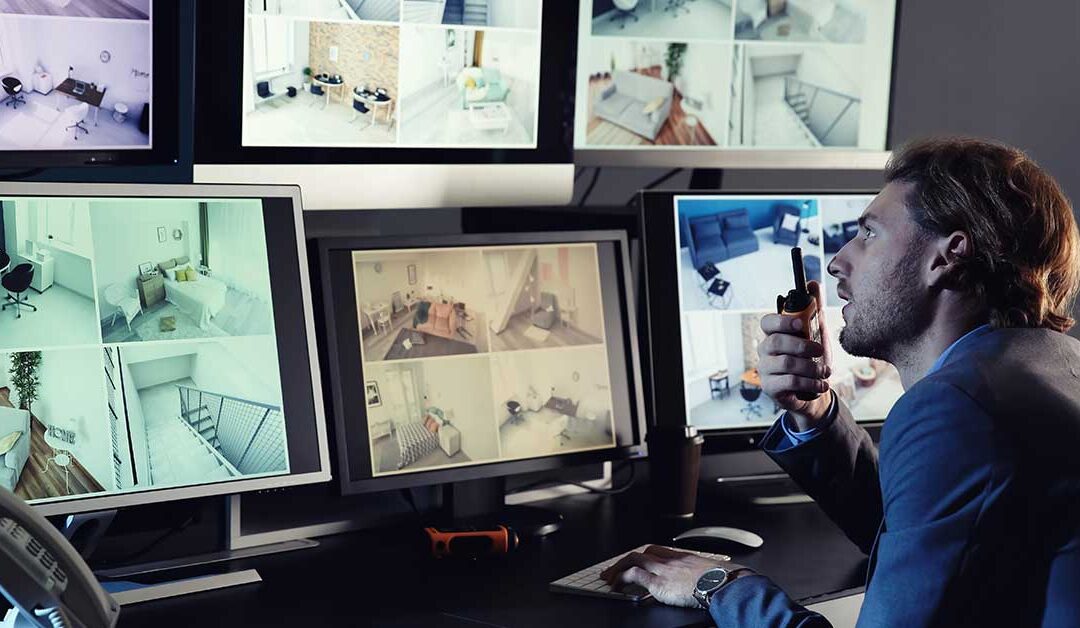
In summary, CCTV monitoring is an advanced security solution, whereby surveillance cameras use motion sensors to detect activity and send instant alerts to an offsite central station.
Operators review the footage in real time and take action if they spot a threat. All in all, if you want to get to grips with this 24/7 crime fighting solution, read our guide to CCTV monitoring to learn more.
Managed from a central monitoring station, these solutions detect and deter critical security threats. In many cases they reduce the cost of security by reducing the need for costly onsite guards.
What is CCTV monitoring & how does it work?
In summary, CCTV monitoring is a cost effective security solution that uses sensor-activated cameras to detect movement and stream footage directly to an alarm receiving centre. When a threat appears, security operators watch the live feed and respond immediately to stop the incident in real time.
Key considerations:
- 24 hour surveillance. Sites are monitored day and night by your IP cameras
- Incident response. Fast action by operatives when threats are detected
- Evidence recording. Video footage is stored for future reference in legal proceedings
- Reduced security costs. CCTV monitoring is often 90% cheaper than employing guards
- Improved security. A monitored site is better protected against the impact of crime
- Integration. Combining CCTV with alarms and access control for an integrated approach to security.
The benefits of sensor activated CCTV monitoring
Altogether, there are significant number of benefits and advantages of using a specialist camera monitoring service.
All in all, these benefits boost security, and are incredibly cost effective, particularly for companies who employ physical guards.
Here are the core benefits:
- Operators review and respond to alarm signals and act the moment something looks wrong
- Audio warnings especially stop intruders before damage happens
- In addition, Police or keyholders get called without delay
- Cameras cover multiple access points at once
- Sites stay protected after hours, weekends, and holidays
- Footage is saved, time-stamped, especially important ready for insurers
- Operators filter false alarms, so you don’t get midnight callouts
- Lastly CCTV monitoring monitoring adapts to any site, from a warehouse to a large solar farm
Keeping reading to learn more about the process, and how monitored surveillance benefits businesses, particularly high risk sites.
What is the CCTV monitoring process?
Understanding the remote CCTV monitoring process highlights its efficiency:
- Motion Detection Triggers: Sensors identify movement in designated zones, initiating the alert process.
- Alert Received: The system sends a notification to the CCTV monitoring station, indicating potential irregularities.
- Live Footage Reviewed: Operators assess the situation by examining real-time video feeds to ascertain the nature of the activity.
- Audio Challenge: If necessary, operators can communicate directly with individuals on-site through integrated speakers. This is a top way of deterring potential intruders.
- Emergency Response or Keyholder Dispatch: Depending on the severity, authorities or designated keyholders are alerted to address the situation.
Altogether, this process ensures that operators identify suspicious activity quickly and deal with it before it becomes a serious problem.
Detecting and dealing with threats fast
Threats and incidents: immediately dealt with by a combination of motion detection and alarms and alerts
And last but not least, the ability to issue audio challenges gives you and additional layer of deterrence and preventing incidents before they escalate into serious threats.
When operators confirm a threat, they take the right action and quickly contact emergency services or keyholders.
This proactive approach minimises potential damages and enhances the overall security posture of the premises.
What type of businesses benefit most?
In summary, sites that at risk of crime and others where the impact of crime would be significant.
These include:
- Solar farms
- Industrial sites
- Fulfilment and distribution
- Education sites
- Warehouses & logistics hubs
- Office blocks
- Car dealerships
- Public sector buildings
- Retail stores and shops
Also, in reality, these solutions are so affordable that most businesses should consider monitored security cameras to protect their sites.
An overview of remotely monitored CCTV for businesses
Let’s take a look at how these settings and businesses benefits from monitored surveillance.
Solar farms
Remote CCTV monitoring deters trespassers and protects high-value solar panels and cabling. Those are just some of the benefits of CCTV monitoring for solar farms.
Altogether, with 24/7 surveillance, any suspicious movement triggers immediate alerts, reducing theft, speeding up response, and keeping your energy generation running smoothly.
Warehouses
As par for the course, Warehouses stock valuable inventory for themselves and their customers. As a result they face regular out-of-hours security threats.
Remotely monitored CCTV protects warehouses detects intrusions, prevents stock loss, and enables faster incident responses, while eliminating the need for costly overnight guards or regular on-site patrols.
Logistics hubs
Logistics sites are busy, high-risk environments. CCTV monitoring helps these sites in number of ways.
Altogether, it helps prevent theft, stop unauthorised access, and quickly alert keyholders to issues. It maintains operational flow while tightening security for valuable assets.
Industrial sites
With hazardous materials and expensive machinery, industrial sites require constant protection from thieves and trespassers.
CCTV monitoring prevents unauthorised access and alerts offsite security teams the moment it detects an intruder. Operators handle threats quickly and take action before they escalate into operational disruptions or financial loss.
Fulfilment and distribution centres
CCTV monitoring reduces internal and external theft risks at fulfilment centres. Altogether, it keeps an eye across your perimeters, deters unauthorised access, and ensures security without slowing down the rapid movement of goods across the world.
Schools, colleges and universities
When schools shut down for summer or long holidays, criminals often target them while staff and students are away. With no one around, CCTV monitoring keeps watch. If someone breaks in or loiters, alerts go out straight away. It’s that simple.
Schools have tight budgets. CCTV monitoring costs far less than hiring temporary security guards to cover evenings, weekends, or school holidays, and it delivers faster, round-the-clock protection.
Offices and commercial buildings
Unattended offices are easy targets, especially after hours. CCTV monitoring offers live surveillance, alerts for break-ins, and verification of threats. All in all, it’s a reliable, lower-cost alternative to static security guards at commercial properties.
In many cases it’s 90% cheaper. Offices are the obvious target for vandals and burglars. CCTV remote monitoring addresses that risk.
Car dealerships
Forecourts don’t close when the office does. After all, thieves know that. Meanwhile, monitored CCTV keeps watch when staff go home, blaring warnings if someone crosses the line and calling for help before a car disappears.
Car sites are exposed to the threats posed by organised car thieves. Robust perimeter and security camera monitoring is a must to address this threat.
Public sector sites & council buildings
Empty council buildings and libraries make tempting targets. CCTV monitoring steps in where staff can’t. If someone forces entry or starts causing damage, the system flags it, and help is on the way.
In the public sector security is of paramount importance. However, cash is limited. Moreover, budget cuts are front of mind across the board. As a cost effective alternative to guards, and security staff, CCTV monitoring is the obvious choice.
Retail stores and shops
Shops are quiet after hours, but that’s when trouble often starts. In these moments, monitored CCTV spots unusual behaviour fast, inside or outside, alerting keyholders and capturing everything for police or insurers if needed.
Ram-raiders doing a smash and grab of an ATM, could be picked up on and health with if a monitored CCTV system was deployed.
Construction sites
When workers pack up for the day, construction sites become easy targets. Tools, cables, machinery, none of it’s cheap, and all of it’s exposed.
CCTV monitoring keeps eyes on your machinery and assets, especially after hours. If someone hops the fence or tries their luck, the alert goes out. Whether it’s a lone intruder or a team with a van, response is fast, and footage is clear.
Farms & agri-businesses
Rural sites can’t rely on neighbours or passing patrols. Tractors, fuel, and livestock draw thieves to farms when no one’s around. Altogether, CCTV remote monitoring protects barns and perimeters 24/7.
Even if your land stretches for miles. Cameras trigger alerts at the first sign of movement. Security teams review footage, issue audio warnings, and raise the alarm before things go missing.
Battery storage sites
These critical infrastructure sites and facilities are often remote locations, unstaffed, and expensive to secure with boots on the ground. That’s why BESS site monitoring is the go-to option.
In summary, these solutions track movement around fenced enclosures, flags tampering or forced entry, and ensures someone is ready to act. Lastly, AI systems help tell real threats from wildlife, and keyholders or police are looped in within seconds of a verified risk.
A few examples of these 24 hour security solutions work in action
Keen to learn more about how these remote security camera monitoring systems work? Here are a couple of examples to help answers the question; what is CCTV monitoring.
A threat at a warehouse
A large distribution warehouse relies on overnight CCTV monitoring to protect its fleet and stored stock. At 2:47am, an intruder is detected near company vehicles. A man is seen walking between vans and checking locks.
Within seconds, the operator issues a live audio challenge, warning the trespasser they’re under surveillance. The man runs when he hears the warning. The team notifies the keyholder and police. Lastly, patrols are sent as an added precaution.
Detecting an intruder at an office block
At 11:19pm, an intruder forces open a fire exit at the back of a multi-storey office building. Immediately, the CCTV monitoring station receives an alert and checks the footage. Upon review, a hooded figure moves through the corridor, trying doors.
The operator issues an audio warning – loud, clear, immediate. On hearing the warning, the intruder freezes, then turns and runs. Our offsite team contacts the site manager, sharing the footage and time stamps. Entry points are re-secured before the morning shift arrives.
Trespass at a utility scale solar farm
At 1:12am, thermal cameras pick up movement along the outer fence of a remote solar farm in Berkshire. Unfortunately, a group of trespassers enters through a damaged section in the perimeter fencing.
A trespasser triggers a sensor. Then, the security operator reviews the footage, confirming unauthorised access. This triggers a pre-recorded audio warning. The group scatters. Local police and the on-call engineer are notified immediately.
Saved footage is shared and reviewed. No damage or theft occurs. The breach is logged, and temporary fencing is arranged within hours.
Integration with other security systems
Combining and integrating monitoring CCTV with systems like access control and alarms creates a pretty robust scurity approach.
When you detect unauthorised entry, cameras automatically focus on the breach point, and alarms notify security personnel instantly.
This coordination ensures rapid responses, reduces blind spots, and offers a more adaptable security solution that can address various threats effectively.
Compliance and legal considerations
Implementing CCTV systems requires adherence to data protection laws to safeguard individual privacy rights. Businesses must ensure clear signage indicating surveillance, limit camera placement to public areas, and securely store footage.
Regular audits and staff training on data handling are essential to maintain compliance.
By respecting legal frameworks, organisations not only avoid penalties but also build trust with employees and customers, demonstrating a commitment to ethical surveillance practices.
Choosing the right CCTV monitoring company
Selecting a reliable CCTV monitoring company involves evaluating their response times, technology infrastructure, and industry experience.
In addition, a reputable provider should offer scalable solutions, 24/7 monitoring, and prompt incident reporting.
Furthermore, client testimonials and case studies can provide insight into their effectiveness. Ensuring the provider aligns with your specific security needs and compliance requirements is crucial for a successful partnership that enhances your organisation’s safety.
Future trends?
The future of CCTV monitoring is leaning towards AI-driven analytics, therefore, enabling proactive threat detection through behaviour analysis and pattern recognition.
Integration with IoT devices allows for smarter, interconnected security ecosystems. Cloud-based storage solutions offer scalable and accessible footage management.
As technology advances, businesses can expect more intuitive systems that not only record incidents but also predict and prevent potential security breaches.
Are there any disadvantages to CCTV monitoring?
While CCTV monitoring offers numerous benefits, it’s important to consider potential drawbacks:
1: Privacy concerns
To summarise, sensor activated 24 hour surveillance may raise privacy issues among employees and visitors. However, implementing clear policies and ensuring transparency can mitigate these concerns.
2: Initial costs
The setup of a comprehensive CCTV system can be expensive. Yet, the long-term savings from crime prevention and reduced need for physical security personnel often offset the initial investment.
3: Maintenance requirements
Regular maintenance is necessary to ensure system functionality. Partnering with a reliable provider can streamline this process, ensuring consistent performance.
4: Potential for misuse
There’s a risk of surveillance footage being misused. Establishing strict access controls and audit trails can help prevent unauthorised use.
5: Technical limitations
Cameras may have blind spots or be susceptible to tampering. Strategic placement and incorporating tamper-detection features can enhance system reliability.
All in all, by acknowledging and addressing these potential issues, organisations can effectively leverage CCTV monitoring to enhance security while maintaining ethical standards.
Summary – our guide to CCTV monitoring
CCTV monitoring is fast becoming a key component in modern security strategies. In summary, it provides real-time surveillance and rapid response to threats and incidents.
Threats detected in real time.
Action taken to prevent crime.
Further action taken where necessary.
By deploying a monitored CCTV systems at your site, businesses can improve safety, deter crime, and maintain a secure operational environment.
FAQs
What is CCTV monitoring?
Unlike standard CCTV, which only records footage for later review, monitored systems allow for real-time intervention.
If an intruder enters a restricted area, the system triggers an alert. Operators can immediately view the footage, issue a live warning through on-site speakers, and contact keyholders or emergency services if needed.
What are the benefits of CCTV remote monitoring?
The first benefit of CCTV remote monitoring boosts security by giving operators live access to your camera feeds. They spot threats as they happen, issue audio warnings, and call for help when needed. This real-time action deters intruders, prevents damage, and protects your property far more effectively than a system that only records events.
Is CCTV monitoring suitable for small businesses?
Yes, CCTV monitoring works well for small businesses. Providers can tailor coverage to fit your site size, risk level, and budget.
Even with a few cameras, operators can watch for threats, respond to incidents, and keep your premises secure outside working hours, without the cost of on-site guards.
What are the benefits of sensor activated CCTV monitoring for commercial buildings?
Sensor activated CCTV monitoring helps protect commercial buildings by preventing theft, deterring intruders, and enabling fast response to suspicious activity.
Furthermore, it also supports staff safety, improves site management, and can reduce insurance costs. With 24/7 monitoring, businesses get constant protection without relying on on-site security teams.
How do you choose a good CCTV monitoring company?
Choosing a good remote CCTV monitoring company is a key decision. Look for a company with a proven track record, trained 24/7 operators, and the ability to integrate with your existing system.
Make sure they offer fast response times, detailed incident reporting, and clear escalation procedures. Check for industry accreditations and real client testimonials before signing a contract.